ἀλήθεια /a.lɛ́ː.tʰeː.a/ · unconcealment

MCP-first
knowledge management.

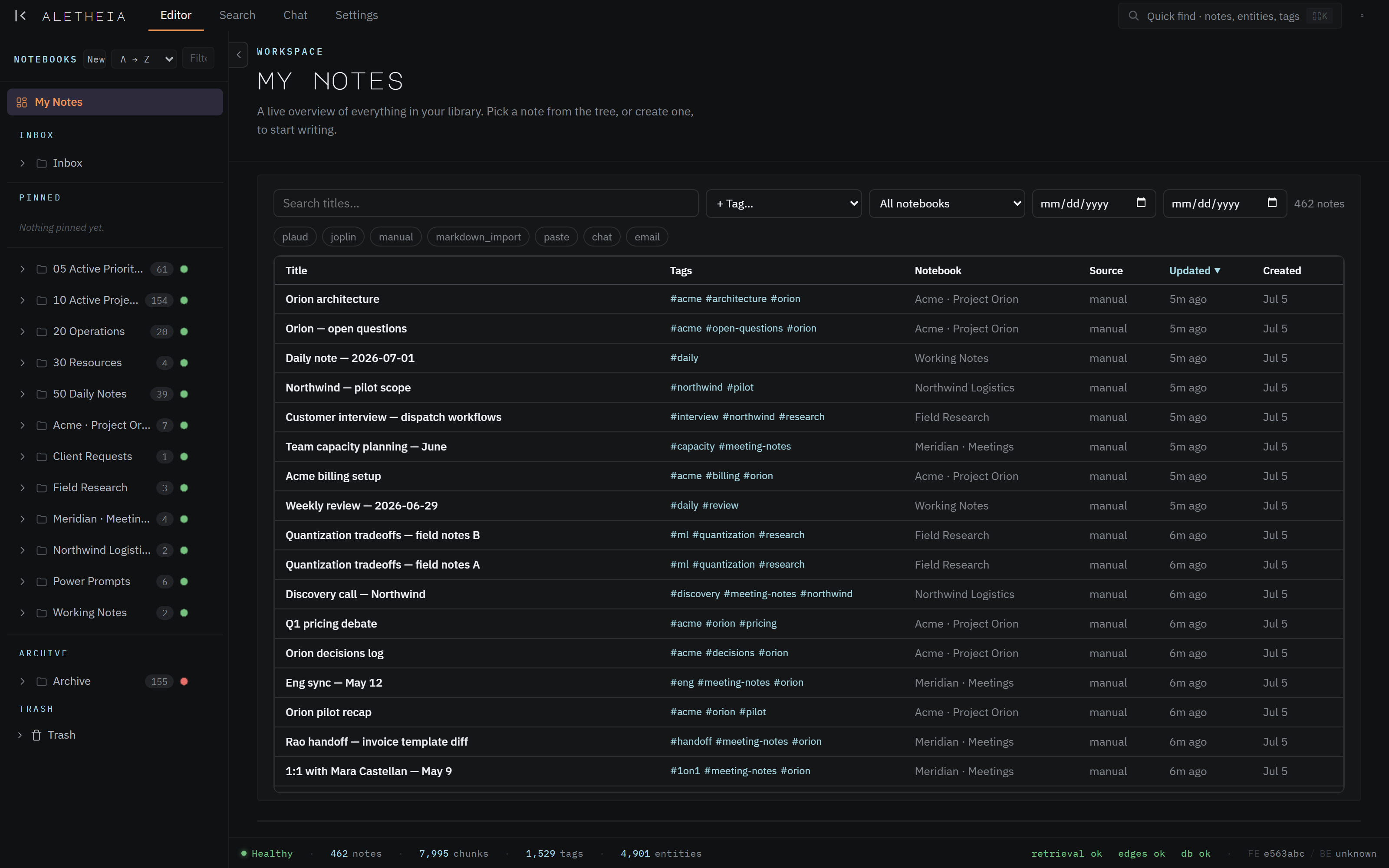
Aletheia is the retrieval-first knowledge substrate your AI talks to directly — over the Model Context Protocol. Voice recordings, meeting transcripts, scattered markdown — captured. Entities resolved, links drawn, contradictions surfaced — automatically. Nothing to file. One corpus, queryable from any LLM, agent, or app via MCP. Memory you can rely on, owned by you.

Hosted · your private workspace | MCP-native · query from any LLM or agent
aletheia · session · 14:02 slate · 1,284 notes indexed
A

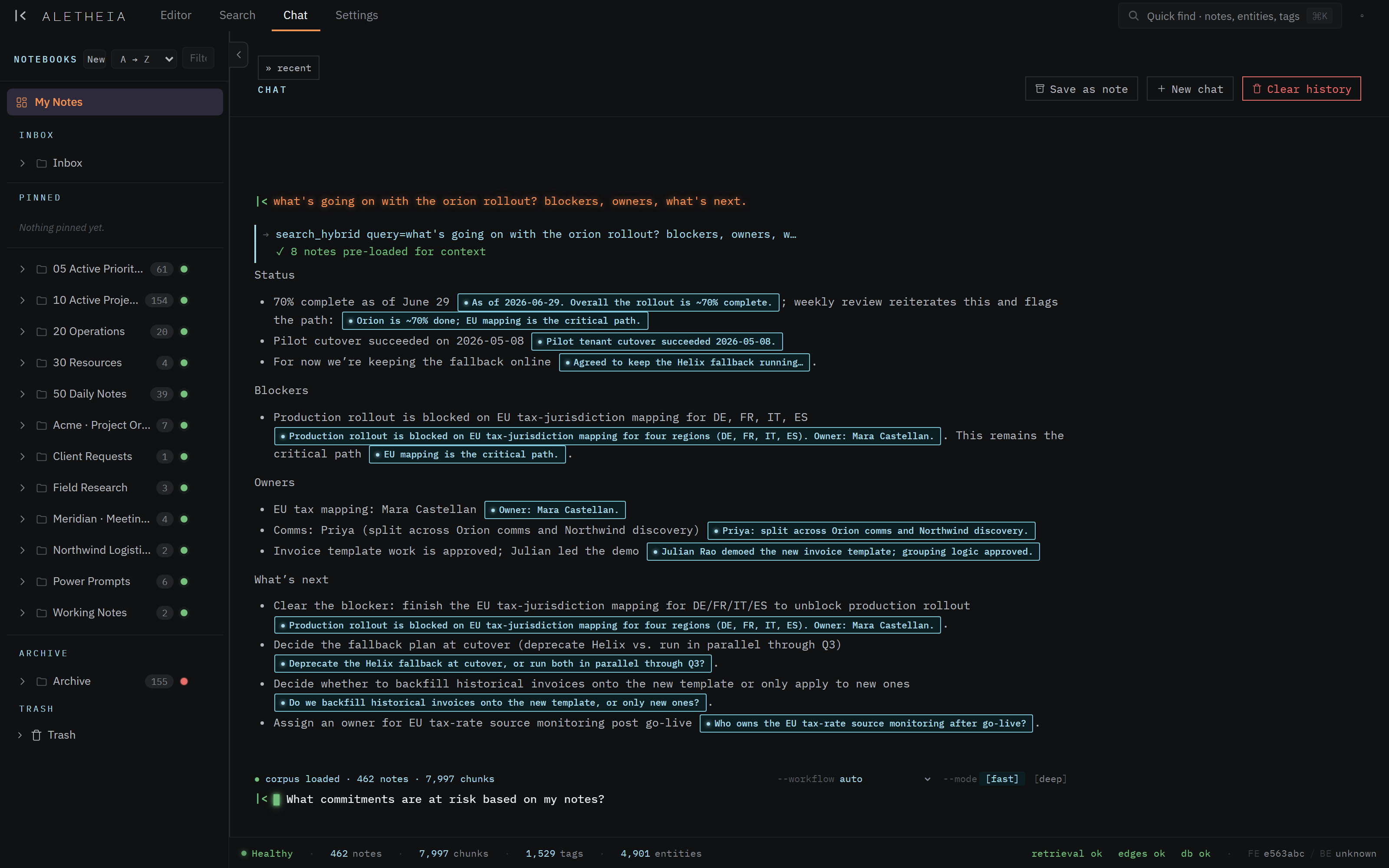
what's going on with the orion rollout? blockers, owners, what's next.

synthesize_topic · matched 47 chunks across 18 notes
find_relationships · resolved 6 entities, 4 owners
building synthesis…

Status

  • Rollout is ~70% complete; pilot tenant cutover succeeded May 8 orion-pilot-recap.md
  • Production rollout blocked on tax-jurisdiction mapping for 4 EU regions eng-sync-2026-05-12

Owners

  • M. Castellan — region mapping, EU jurisdictions 1:1 castellan · may 09
  • J. Rao — invoice template diff, integration tests rao-handoff.md

Open questions

  • Are we deprecating the legacy Helix fallback at cutover, or running both in parallel for Q3? orion-decisions
the problem

You're capturing faster
than you can synthesize.

01 · the inflow

The transcripts pile up

You record every client call with Plaud. You run Granola on every Zoom. Otter on the rest. Your inbox fills with transcripts. You re-read maybe one in twenty.

02 · the model memory

The model forgets, opaquely

You ask an LLM to remember things, and sometimes it does. You can't see what it kept, can't audit when it was wrong, can't take it with you when the model changes.

03 · the filing tax

The note apps want a clerk

You tried Notion. You tried Obsidian. Both made you the filing clerk for your own brain. You wanted thinking; they wanted hierarchy.

Aletheia is the substrate underneath. You capture. It extracts, links, resolves, and surfaces — automatically. You query from whichever LLM you're using today, against a knowledge layer you actually own.

why aletheia

Four things that change
everything else.

Most "chat with your notes" tools are a vector search with a chatbot bolted on. Aletheia is structured retrieval first, generation second.

01 / synthesis

Synthesize, don't summarize.

Purpose-built workflows hunt for decisions, blockers, ownership chains, and open questions — not just keyword matches. Ask a question, get a synthesis. Seven workflows, routed by intent.

workflow → synthesize_topic
02 / citations

Citations or it didn't happen.

Every claim links to the exact note, with timestamp and capture source. Inline pills you click to jump straight to source. No "according to my training data" — if we don't have a source, we say so.

retrieval-first · zero hedging
03 / portability

Your notes, your substrate.

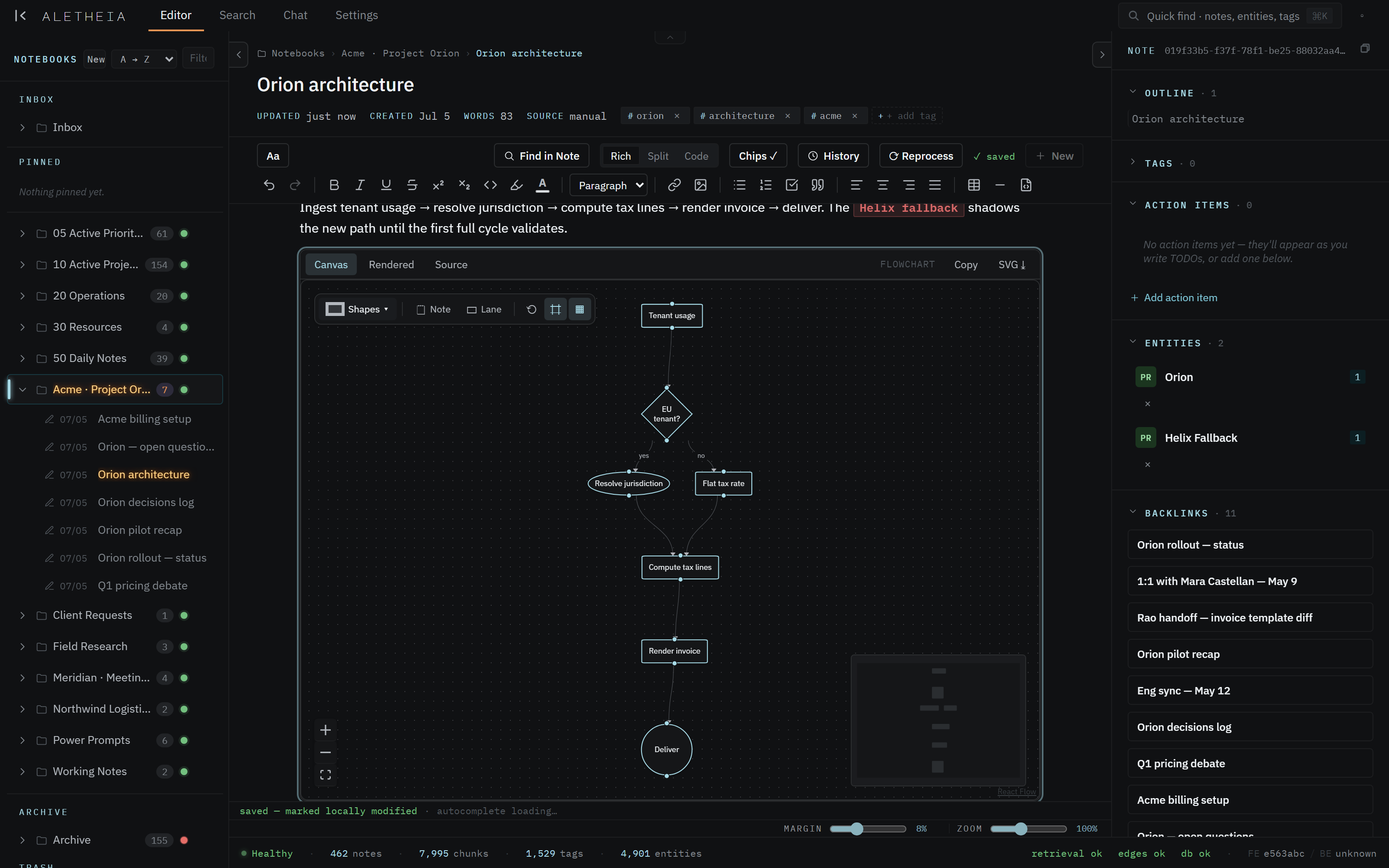
Postgres + pgvector under the hood. Universal markdown plus YAML in, universal markdown plus YAML out. Every supported tool round-trips. No proprietary format you can't escape.

markdown + yaml · postgres + pgvector
04 / entities

Built to know things.

Auto-resolves people, companies, projects. Builds the entity graph as you capture. Co-occurrences, n-hop neighborhoods, relationship paths, entity timelines — without you filing anything.

capture-and-forget · the graph emerges
voice-first capture

The structured destination
voice capture has been missing.

Plaud, Granola, Otter, Limitless — every voice-capture tool ships its own thin summary feature and drops the transcript in your inbox. Aletheia is the substrate underneath them. You record the way you already record. The structure happens on the other side.

source
what happens
Plaud transcripts
Email-to-Joplin pipeline. Entities, decisions, and tags extracted on ingest.
Granola summaries
Markdown sync. Speakers preserved, action items lifted into your plate.
Otter exports
Drag-and-drop. Attribution and timestamps preserved.
Zoom recordings
Audio in, transcript + structure out. Local processing or cloud, your call.
Limitless / wearable
Ambient transcription in, entity-resolved notes out.
Email captures
Forward-to-address. Parsed, threaded, filed by entity.
Joplin / Obsidian
Native sync. No migration required, no proprietary capture.
Plain markdown
Drop a folder, watch the count tick up.

The transcript that used to die in your inbox becomes part of a queryable graph the same minute it arrives. Capture-and-forget.

seven workflows

The LLM picks
the right one for you.

Each workflow is a separate retrieval + reasoning chain tuned for a specific shape of question. You don't choose — Aletheia routes based on intent. Available in the built-in chat or to any LLM you connect via MCP.

01
Synthesize topic

Status, decisions, open questions, next actions for any topic.

"what's going on with the orion rollout?"
02
Find relationships

Entities, tags, and supporting passages connected to any subject.

"what's connected to castellan?"
03
Build timeline

Chronological narrative of any topic, every beat linked to source.

"timeline: q1 pricing debate"
04
Find notes

Filtered, scoped search with rich previews and provenance.

"notes tagged #1on1 in the last 30 days"
05
Find quotes

Verbatim passages with context windows, ready to drop into a draft.

"quotes from the october customer interviews"
"
06
What's on my plate

Open action items extracted across notes, grouped by owner.

"my open items, by project"
07
Find contradictions

Conflicting statements surfaced across notes with both sources side-by-side. The one workflow nothing else does.

"contradictions in my notes about quantization tradeoffs"
who it's for

Built for people
who capture for a living.

persona / 01

The independent consultant

Multiple clients, each with their own thread of context. Five recorded calls a week, sometimes ten. Currently using Plaud or Granola; transcripts pile up faster than synthesis.

"what do I know about acme corp's billing setup?"
Entity dossier: people involved, key meetings, open questions, dates. Pulled in under a minute from a corpus you'd never re-read manually.
persona / 02

The program manager

Five live projects, dozens of meetings a week. Notes scattered across Joplin, Slack threads, email summaries. Status updates that should take ten minutes take ninety.

"what's the status of the orion rollout? what blockers? who owns what?"
30-second synthesis with named owners, the actual decisions, and what's still pending Monday.
persona / 03

The solo founder

Discovery interviews, investor conversations, team check-ins. Captures everything because it's all signal — and re-reads almost none of it.

"every time pricing came up in the last quarter, what did the customer say?"
Pattern across recorded conversations, with the quotes, the speakers, and the dates.
persona / 04

The executive coach

Long-horizon client engagements. Tracks themes, commitments, and shifts across months across many clients.

"how has my read of leadership at portfolio company X shifted over time?"
Timeline of your own evolving assessments, with the source captures behind each beat.
persona / 05

The serious writer / analyst

Reading and note-taking across hundreds of sources. Threading arguments, finding contradictions, building timelines. Citation discipline is the job.

"find contradictions in my notes about quantization tradeoffs."
Conflicting claims surfaced with source citations side-by-side.
who it's not for

Honesty saves you
a trial.

Aletheia is overbuilt for some workflows and unsuitable for others. We'd rather you self-select than churn at week three.

Casual note-takers

Under five substantive captures a week, your LLM's built-in memory or a plain notes app is enough. Aletheia is overbuilt for you.

Heavy Obsidian users on principle

If local-first is your hill, we're not it. We respect the philosophy and won't try to talk you out of it.

Teams committed to Notion as the writing surface

Notion is a great canvas. Aletheia sits underneath it, not next to it. Try us if you want a substrate; not if you want a replacement.

Anyone who wants a chat-with-PDF wrapper

That's not what this is. There are good tools for that question — we're not one of them.

how it compares

Underneath the AI notes apps,
not next to them.

The category ships the same three features in a trenchcoat — chat-with-your-notes, auto-tag, summarize-this-page — and stops there. Aletheia is a different bar. Here's the honest map of what we replace, complement, and ignore.

vs · built-in llm memory + projects

The model is interchangeable. The substrate isn't.

A model's memory is opaque, lossy, and vendor-held. You can't audit it, query it directly, or take it with you when the vendor changes the format. Aletheia is the substrate underneath; the model is one of several reasoning heads on top. Mature setups have both.

vs · notion ai

Notion is a canvas. Aletheia is queryable memory.

Notion is a collaborative document canvas with a chat sidebar bolted on. Aletheia is the entity graph and temporal layer over your captures. Different jobs. Use both.

vs · mem / reflect

Embedding search + chat box ≠ retrieval engineering.

They ship vector search and a chat box. Aletheia ships entity resolution, temporal reasoning, and contradiction detection. Different depth. Their retrieval flatlines as the corpus grows; ours improves.

vs · obsidian + smart connections

Brilliant if you love filing. We're not it if you don't.

Obsidian is brilliant if you love filing. Aletheia is for people who don't have time. We import from Obsidian; many users keep both.

vs · tana

Schema up front vs. structure that emerges.

Tana asks you to design supertags and queries before the value shows up. Aletheia asks you to capture and lets structure emerge. Same destination, opposite architectural bet.

vs · the ai notes app category

The wrong category to be in.

Mem, Saga, Reflect, and a dozen others ship the same three features bolted onto a notes UI with no opinion on retrieval quality or graph reasoning. Aletheia isn't an AI notes app. It's the substrate underneath.

how it works

Corpus → retrieval → synthesis →
any LLM via MCP.

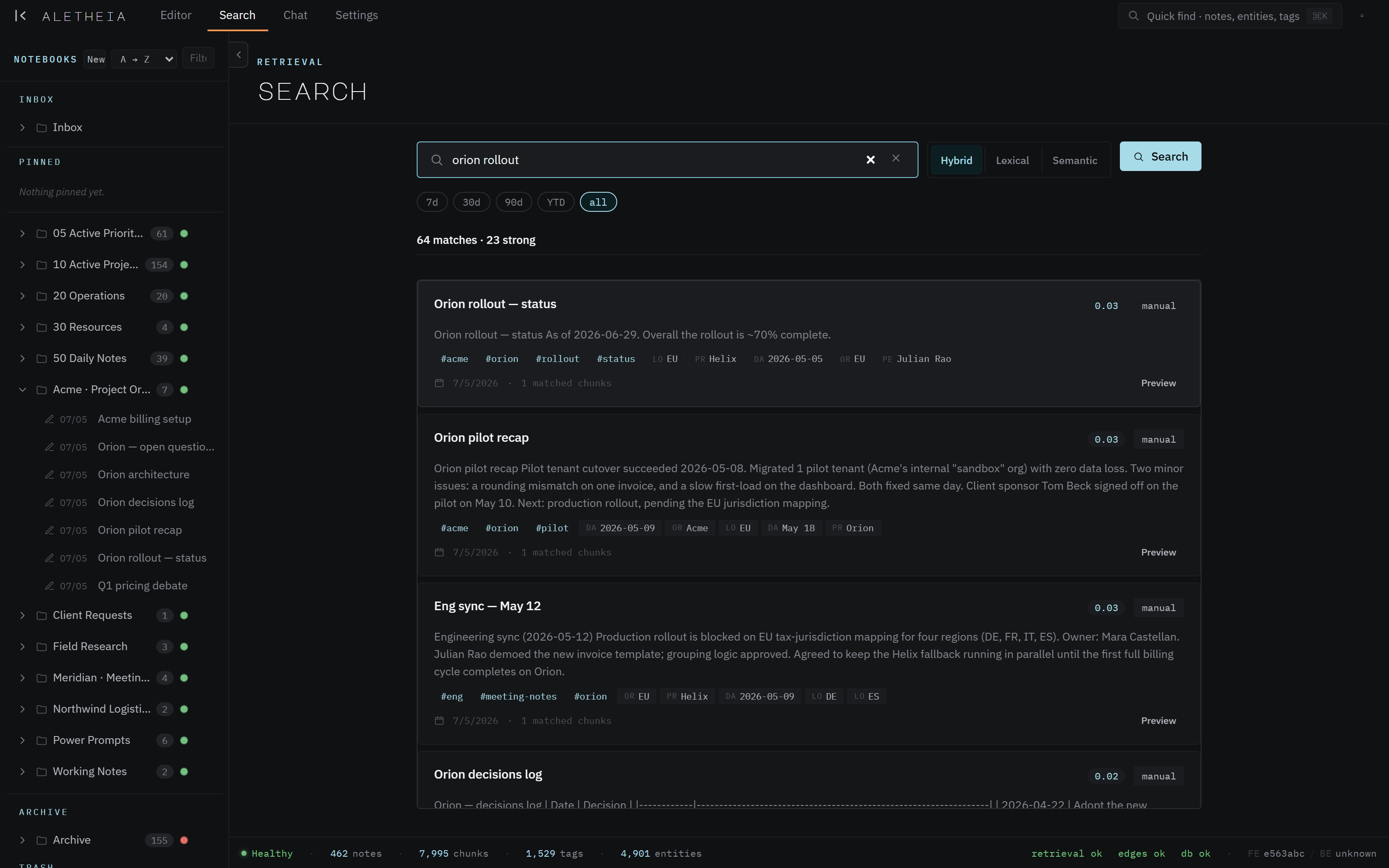
Hybrid retrieval (BM25 + embeddings + tag-match), section-boosted rerank, then the right synthesis workflow for the question. Exposed via MCP so any model can call it.

stage / 01
Corpus
1,284 notes
joplin/raw-export412
obsidian-vault318
notion-export204
meetings/plaud187
research/papers163
stage / 02
Retrieval
rrf · k=24
lexical · bm25 0.78
semantic 0.91
tag-match 0.64
## decisions +rerank
## open q's +rerank

structured chunks (## decisions, ## open questions) get amplified.

stage / 03
Synthesis
cited
Pilot cutover succeeded May 8 orion-pilot. Blocked on EU jurisdiction mapping eng-sync. Owners: M. Castellan (regions) 1:1 castellan, J. Rao (invoices) handoff.

every claim → click → source note.

stage / 04
MCP
~40 tools
built-in chat · gpt
any desktop llm client
any web connector
custom agents
your next model

switch the client, not the substrate.

interop

Bring it in. Take it out.

No lock-in. Universal markdown is the substrate — every supported tool round-trips.

Import from anything

One-click import. Drag the export, watch the count tick up, ask a question.

Joplin RAW Obsidian vault Notion export Logseq graph Markdown ZIP PDF · 100MB Plaud · Otter · Granola raw audio images · OCR

Export to anything

Markdown plus YAML frontmatter, packaged as a ZIP. Opens in any tool, forever.

Markdown + YAML JSON dump SQL export git-friendly

$ aletheia export --format=md --out=./vault.zip

pricing

Simple. Honest.
Predictable.

Flat-rate pricing for managed infrastructure, synthesis pipelines, and MCP access. No surprises, no over-the-line bills.

solo
$20 /mo
For one professional with a serious capture practice.
  • Managed cloud, private Postgres
  • All seven synthesis workflows
  • MCP server for any MCP-capable LLM client
  • Universal import & export
  • 10K notes / 100K chunks
  • Hard cost cap, auto-halt
  • Daily backups
Start free trial
pro · most popular
$40 /mo
For the high-volume operator. 10+ recorded conversations a week.
  • Everything in Solo
  • 50K notes / 500K chunks
  • Priority extraction queue
  • Advanced graph: path-finding, n-hop, contradiction-at-scale
  • Audio transcription credits
Start free trial
team
$25 /seat · 3 min
Boutique consulting firms, research shops, small investment teams.
  • Shared workspace, per-user scoping
  • Role-based corpus access
  • Audit log
  • Per-seat MCP credentials
  • Centralized billing
  • SSO & SCIM (roadmap)
Contact sales
faq

The honest answers.

Tap to expand. We tried to answer the questions you'd actually have, not the ones marketing wants you to ask.

Q · 01 Why not just use my LLM's built-in memory? +
The model is the model. Aletheia is the substrate. A model's built-in memory is opaque, lossy, and vendor-held — you can't audit what it kept, can't query it directly, can't take it with you when the format or vendor changes, and can't reason temporally against it. Aletheia is the substrate underneath; the model is one of several reasoning heads on top. Mature workflows use both.
Q · 02 Why not just use Notion AI? +
Notion is a collaborative document canvas. Its AI is summarize-this-page and draft-this-email. Aletheia is a retrieval and reasoning layer over captures — entity graphs, temporal queries, contradiction detection. Different jobs. Notion users add Aletheia underneath; they don't replace Notion with it.
Q · 03 Can I really export everything? +
Yes. Markdown + YAML, JSON dump, or SQL export. Run the command, get a ZIP. If you ever want to leave, leaving is one command — you walk away with everything you put in.
Q · 04 What models does it work with? +
The built-in chat uses GPT. If you want something else — a different vendor, your team's preferred model, an experimental open-weights setup — connect it via MCP. The substrate is model-agnostic by design. When the next-best model ships, you switch the client; the substrate doesn't move.
Q · 05 Is this another "second brain" app? +
No — and it's not an "AI notes app" either. Second-brain tools assume you'll manually file, link, and review. AI notes apps bolt a chat sidebar onto that filing workflow. Aletheia assumes the opposite: you capture and forget, and the system does the filing, linking, and surfacing on its own. It's the substrate, not the interface.
Q · 06 Does contradiction detection really work? +
It works on statements about the same entity across different captures. "Castellan said X about pricing in March" vs. "Castellan said Y about pricing in May" gets flagged with both sources. It is not a fact-checker against the external world. It's an internal consistency check on your own corpus.
Q · 07 What's actually included in the subscription? +
Everything you need to use the product. Managed Postgres, the synthesis pipelines, extraction queues, daily backups, the MCP server, and the seven workflows. One flat price, hard monthly cap, auto-halt before any overrun. No metered surprises.
Q · 08 Is there a free tier? +
No permanent free tier — 14-day trial. Free tiers attract use cases the product isn't built for, and the infrastructure underneath has real cost. The trial is enough to test against your real corpus before you commit.
Q · 09 Why "Aletheia"? +
Greek ἀλήθεια — unconcealment. The act of bringing the latent to the surface. Your notes already know what you've decided, who you've met, and what's still open. The product just reveals it.
ἀλήθεια · unconcealment

Reveal what your notes
already know.

Create a workspace, drop in your vault, ask the first real question of your own corpus. It takes about four minutes.